
Using a 0.05 BTC Target as a Hardware Filter, Not a Promise
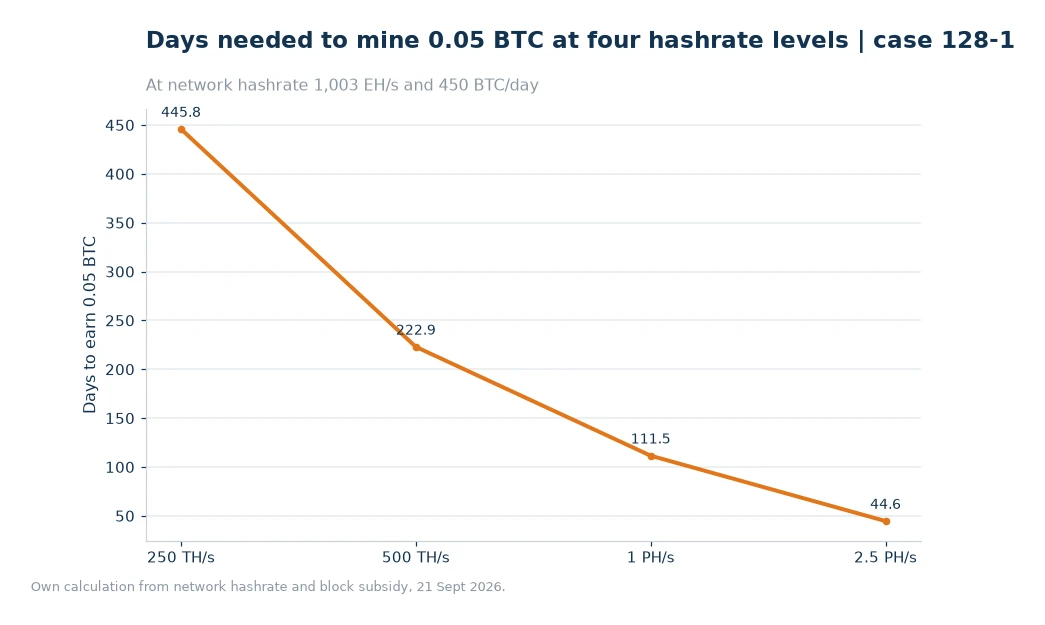
Sellers quote daily income because the number looks encouraging. Buyers need a date, because a date is what compares against a price. Set the goal at 0.05 BTC and the question becomes concrete: 250 TH/s needs 445.8 days, 1 PH/s needs 111.5 days, and 2.5 PH/s needs 44.6 days at current network conditions. Those three answers sort a shortlist faster than any spreadsheet of specifications.
Key takeaways
- 0.05 BTC is worth $4,234.60 at $84,692, which makes it a natural yardstick for a hardware invoice.
- Reaching it in one year requires about 305 TH/s of steady hashrate at today's network total.
- Pool Hashrate and Pool Luck describe the pool's side of the arrangement; your own output depends on the network total.
- A machine that takes 445.8 days to produce the target has to survive 445.8 days of difficulty change to deliver it.
A seller's daily income figure is not a payback figure
Daily income answers a question nobody asks at the till. What a buyer wants to know is how long the machine must run before the coins it produces equal the money it cost, and that requires a target rather than a rate. The moment the target is fixed, every candidate machine gets a number in days, and the comparison becomes honest.
There is a second reason to prefer the target framing. Daily income invites a comparison between machines on one axis, usually hashrate per dollar, while ignoring the timeline over which the return arrives. Two rigs can produce identical daily values and very different cumulative totals by the time the first difficulty adjustment lands. A date forces that difference into view.
Turning a target into a purchase test
The test has three inputs: the target in BTC, the machine's hashrate, and the network's daily issuance divided by its total hashrate. Everything else is presentation. If the resulting date is longer than the period you are willing to keep the machine powered, the purchase fails the test regardless of how good the hardware is. If it is shorter, the remaining question is whether the price leaves room for power and for the risks you cannot measure.
That is a deliberately blunt filter, and blunt is what a purchase decision needs. A rig that reaches 0.05 BTC in 44.6 days at 2.5 PH/s is not automatically a better buy than one that takes 111.5 days at 1 PH/s, because the first costs more and draws more power. What the date does is stop the comparison from being about daily income alone, which is the number the seller controls the framing of.
Where Pool Hashrate and Pool Luck fit
The ViaBTC BTC Mining Pool view lists the network total, the pool's own hashrate and its recent luck together, which is the fastest way to keep all three inputs current. Read it on the morning you compare prices rather than a week earlier: the network total moves with every difficulty adjustment, and a date computed from an old pair of numbers looks more precise than it is.
Pool Hashrate tells you how much of the network the pool represents, and it matters for how frequently blocks appear in the pool's history. Pool Luck tells you whether recent finds beat or lagged the statistical expectation for that share. Neither changes your own expected output, which is set by your hashrate against the network total, but both shape how the pool's performance looks week to week.
A buyer reading a pool's dashboard for the first time often mistakes a lucky month for a permanent advantage. Over a year the series tends to drift back toward expectation, which is precisely why the target-date calculation should use the network total rather than a recent run of good blocks. If the settlement scheme is PPLNS, luck does flow into payouts, and the honest way to model it is as variance around a mean rather than as extra income.
What the date leaves out
A days-to-target figure is silent about three costs that decide whether the purchase works. The first is power: a rig's wattage times the local tariff times the days in the plan. The second is uptime, because every hour offline pushes the date out without reducing the invoice. The third is resale, since a machine that is still healthy when the target completes has a value the calculation ignores, and one that fails before then has a repair bill the calculation also ignores.
Add the first two to the price and the comparison changes. A cheaper machine with worse efficiency can lose to a dearer one over 445.8 days, and a machine that needs a fan replaced twice in a year can erase the advantage of a lower purchase price. This is not an argument against the filter; it is a reminder that the filter narrows the field and the ledger picks the winner.
What four machine sizes deliver in a month
The table keeps the target fixed and varies the hardware, then adds a monthly view so the date can be read against an operating budget.
| Unit | Daily output | Calendar to 0.05 BTC | Monthly coins | Monthly value |
|---|---|---|---|---|
| 250 TH/s | 0.00011215 | 445.8 | 0.0033645 | $284.93 |
| 500 TH/s | 0.00022430 | 222.9 | 0.0067290 | $569.85 |
| 1 PH/s | 0.00044861 | 111.5 | 0.0134583 | $1,139.71 |
| 2.5 PH/s | 0.00112153 | 44.6 | 0.0336459 | $2,849.16 |
Worked example
Suppose the plan is to reach 0.05 BTC inside a year. Work backwards and the required hashrate falls out of the division.
- Daily target: 0.05 ÷ 365 = 0.00013699 BTC.
- The per-TH/s figure comes from 450 ÷ 1,003,000,000, or 4.4865e-7 BTC daily and 4.5e-07 rounded.
- Required hashrate: 0.00013699 ÷ 0.00000044865 = 305.3 TH/s.
- Sanity check at 250 TH/s: 250 × 0.00000044865 = 0.00011216 a day, close to the chart's 0.00011215, and 0.05 ÷ 0.00011216 = 445.8 days, slower than the year.
- At 500 TH/s: 0.00022430 a day, and 0.05 ÷ 0.00022430 = 222.9 days, comfortably inside the year.
- Value of the target: 0.05 × 84,692 = $4,234.60.
The 305 TH/s answer is the useful one for a buyer, because it can be compared with real hardware options instead of with a vague ambition. It also shows why the middle of the range is crowded: a single mid-size machine lands close to the one-year line, and small changes in hashrate move the date by months rather than days.
Frequently asked questions
Is 0.05 BTC a realistic target for one machine?
It depends on the machine. A 250 TH/s unit needs 445.8 days at current figures, while a 1 PH/s unit needs 111.5 days, so the target is realistic for larger hardware and a long commitment for smaller hardware.
Should I use daily income or days-to-target when comparing miners?
Days-to-target, because it includes the time over which difficulty changes and hardware ages; daily income alone hides both, and both decide whether the machine still earns by the time it reaches the goal.
Does Pool Luck improve my expected time to the target?
Only under PPLNS, where payouts follow what the pool actually finds; under PPS+ the block-reward component settles against difficulty, so luck does not change the expected date.
Price the date, then price the machine
Write the target at the top of the page, put each candidate's days-to-target beneath it, and cross out everything that misses the window you set. What remains is a short list small enough to price properly, including power, cooling and the cost of replacing a failed board. The Miner Profitability Ranking gives current model-level figures to compare against, and a Collateral-Pledged Loans facility is one way some operators fund the gap between the invoice and the first payout, though borrowing adds a cost that belongs in the same comparison.
Sources: ViaBTC pool-state, ranking and finance pages, the reference for Pool Hashrate, Pool Luck and model-level data; 4% is the listed rate on the block-reward side[1]. Readings from 21 Sept 2026 — network 1,003 EH/s, 3.125 BTC subsidy, 144 blocks daily, BTC $84,692. Live from 24 October 2026; every date assumes steady difficulty and no downtime.